Category Archives: Project Blog

This blog will record the progress of the project as we go along.

More on Little Brown Jobs (LBJs) and Happy Christmas!

More on Little Brown Jobs (LBJs) and Happy Christmas!

Another Little Brown Job (LBJ) is the Redpoll (see December 2017 blog). It has a troubled taxonomic history. The species that breeds in England, Wales and (parts of) Scotland is designated the Lesser Redpoll. It has been separated from the Common Redpoll but in Ireland both “species” are considered the same – Common Redpoll.

Lesser Redpoll used to be a regular breeder in our project area; in spring displaying males could be heard in song flight over Romsey Town, Cherry Hinton and Petersfield. In 1989 a male was singing from the telegraph wires above Ridgeon’s wood yard in Cavendish Road. Within ten years it had disappeared as a breeding species in, not just Cambridge City but Cambridgeshire – the last confirmed breeding was in Coleridge in 2002, although a displaying bird was heard over Carlton Way/Gilbert Road in spring 2016.  A warming climate seems to be the reason this arboreal finch has receded north and west with a strong increase in Ireland. It is now a winter visitor to our project area and should be looked for feeding on Alder catkins – Newnham park play area and Milton Country Park near the apple orchard are good sites. It is a small Linnet-like Little Brown Job (LBJ) – the males have a red forehead (“poll)” and a black bib. It has a very distinctive flight call. Flocks may contain Common Redpolls which are paler with distinct whiter wing bars.

Siskins often accompany Redpoll flocks in winter and also feed on Alder catkins and visit garden feeders. They have distinctive yellow rumps and wing-bars. They breed in conifer woods, are common in the Thetford/Brandon Brecklands, but displaying males often linger in spring and singing birds have been seen in Cherry Hinton Hall park in late April.

Siskins in Chesterton
December
11-14th 2017

Another record of a single Stonechat from our project area – Trumpington, Country Park from Guy Belcher.

A walk along the Riverside will produce (Grey) Herons, Cormorants on the willows near Logan’s Meadow, possible Water Rail in Logan’s Meadow nature reserve, wintering Chiffchaff and Kingfisher (given away by its distinctive flight call – a loud “jeet”), winter plumage Black-headed Gulls and Green Woodpeckers often “grubbing” for ants.

Blackcap records for this winter period have come from Benson Street, Alpha Road and Longworth Avenue.

Male Sparrow Hawk sitting on a balcony rail, Riverside [left] and (Grey) Heron [right], Riverside (thanks to Nigel Fuller)

Cormorant [left] Anting Green Woodpecker [middle]  Winter-plumage adult Black-headed Gull (thanks again to Nigel Fuller)

Couldn’t resist the seasonal
Robin sitting-on–the-garden-fork-handle photograph

Happy Christmas

bobjarman99@btinternet.com

December sightings

Lots of bird reports this month!  Guy Belcher (City Biodiversity Officer) saw a Stonechat in the Trumpington Country Park on Dec 1st and a female Peregrine on Kings College, sitting in the sun, on Dec 18th.  A mixed flock of Blackbird, Redwing and Song Thrush were feeding on yew berries near the market place and several redwings were seen in a garden near the Grafton Centre, together with both male and female Blackcaps. A female blackcap was also seen in Alpha Road. In Petworth St, a Jay comes regularly to eat mealworms. In Romsey, blackbirds, tits and sparrows are regularly seen in a tiny garden. In Newnham, a neighbour reports a group of about 10 Long-tailed Tits at the feeders every day, with Blue and Great Tits, Chaffinches (no goldfinches yet), a Robin singing very loudly and visibly and a Wren singing unseen. Also up to four Blackbirds feasting on crab apples every day – she said it looked like a Christmas card. By the river, the daily routine of about 300-400 Rooks and Jackdaws continues, a noisy gathering at 7am and 4pm.  Val Neal’s early morning excitement was “A Kingfisher, flying along the river parallel to our boat as we both headed upstream.” Finally, I have a report of a Snow Petrel. (Don’t get excited, Bob!) Jonathan Shanklin mailed this from  the Halley Research Station, Antarctica, where he is meteorologist spending the summer – so slightly outside our study area.

Those of us who love cats are often upset by the wildlife they catch. Sometimes, it is possible to rescue the animal and return it to the wild unharmed, as a neighbour found with a Field Mouse this week. Over the years, my cats have presented me with an unharmed Pipistrelle Bat, a Moorhen, various mice and voles and even a Kingfisher, all of which I returned to the wild.

Female kingfisher brought in by the cat

Hedgehog reports continue to come in, though sadly, many are of those killed on the road. Ann Laskey says, “I saw the skin of a dead hedgehog on the pavement in Hills Road. There was another dead one in our garden. Its remains were being fought over by a magpie and a crow.”

I asked for sightings of creatures which had sought shelter inside our houses. Someone replied, “Invertebrate-wise, I have any number of “dancing” Spiders in my house (the only ones that I can tolerate) – very small bodies and long cotton legs.  And a large Wasp managed to get into my front bedroom, despite the fact that the window hadn’t been open.”

Pholcus phalangiodes

These spiders would be the Daddy-Long-Legs Spider, Pholcus phalangioides, common indoors, but not found outdoors in Northern Europe.

Two reporters have asked to remain anonymous! One says, “ I came down to the kitchen at 2am and found a huge Slug on the floor. It must have been at least 10-12 cm long, yellowish with darker patches. It did explain the slime trails I had noticed occasionally!” This would be either the Yellow Cellar Slug, Limax flavus or the Green Cellar Slug, Limax maculatus and from the size, more likely the latter. As their names suggest, both are likely to be found indoors in damp places, breeding behind kitchen units or in cellars and feeding on pet food or other scraps. As they are nocturnal, they are rarely seen and difficult to eradicate. (But how do they know when it is time to get up and get going?)


Limax maculatus   Graham Callow

 Finally, a Worm! “I found my kitchen sink was not emptying well, so took the plunger to try and clear it. This worked fine, but then I noticed the front end of an Earthworm emerging from the overflow hole. I managed to get it into the compost bin and hope to goodness it was a loner and not part of a breeding colony.”

I do understand these requests for anonymity!

Many thanks to all contributors over the last year

Happy Christmas and New Year

Olwen Williams

A snout at the Snout and LBJs (Little Brown Jobs)

Snout Corner is in the most north-easterly 1×1 km square of our project area. This monad and the the 1×1 km square just below, adjacent to the A14, are mostly winter wheat and sugar beet farm land and quite barren for birds. But …the adjacent fields just outside our project area are weedy cereal stubbles full of Yellowhammers, finches and wintering thrushes – a good example of the value and diversity that over-winter stubbles offer as bird habitat in intensive farmland. I have seen Roe Deer at Snouts Corner in the past but have records of up 16 Roe Deer seen there recently. There is a public footpath and it is worth a visit!

I received an interesting record of a male Stonechat from the Histon Road allotments from Ben Greig, which he saw in February 2017. This is a good record – stonechats are rare birds in our study area and within the county are uncommon winter visitors and passage migrants and only occasional breeders, mostly to open weedy marginal land in the fens. I have seen only two before in our study area on farmland just south of the A14. The margins around the ponds at Eddington look like potential stonechat sites.

Female Stonechat

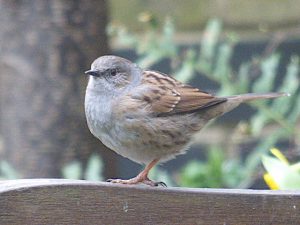
Little Brown Jobs (LBJs) are birds that can be very difficult to identify. Immatures, females of some species and moulting adults cause problems. A classic LBJ is the Dunnock (Hedge Sparrow). Tweet of the Day recently featured the Dunnock with a commentary by Dermot O’Leary (X-Factor compère). He has big respect for this bird because it always seems busy – a grafter! But this bird has its secrets. A classic study by Nick Davies many years ago in the Cambridge Botanic Gardens showed that female dunnocks select an alpha male but also sneak off to mate with a beta male: she is polyandrous. The young are the offspring of both males and all three adults feed the young. It’s a brilliant strategy: if the Alpha male is taken by a predator it still leaves two adults to raise the chicks.

DunnockDunnock

A note in the September/October Bulletin of the Cambridgeshire Bird Club says: Studies of the Cambridge Peregrines have shown that as well as feral pigeons, prey items include Teal, Shoveler, Grey Partridge, Golden Plover, Bar-tailed Godwits, Black-tailed Godwits, Woodcock, Common Tern, Blackbird, Redwing and Starling. These birds may not have been caught over the City. I suspect the City birds travel out to the Ouse Washes (Earith to Sutton Gault). I have seen birds travelling out of Cambridge on several occasions and this seems a regular direction.

Also mentioned in the CBC Bulletin is a fascinating study of night time calls of flyover birds including a record of Ortolan Bunting over our study area. Ortolan Bunting has never been seen in Cambridgeshire and is a rare east coast passage migrant from central Europe. In autumn plumages it is a classic LBJ!.

Bright days in winter often encourage Mistle Thrushes to sing. Their mournful song from the top of a tall tree gives hope of warmer and longer days ahead, I have heard two birds singing recently in Fen Ditton and Midsummer Common. I have seen them feeding on the grassy roundabout and singing from the tree tops at the junction of Chesterton Road and Elizabeth Way.

Duncan’s blog with photographs of Buzzards over the City is spectacular. Buzzards breed just outside our study area.

We now have Buzzards, Peregrines and occasionally Red Kites over the City. Red Kites have bred in our study area. In October 2016 at the junction of Gilbert Road with Histon Road, a Peregrine made a pigeon kill. It was being closely tailed by a Red Kite; the kite was probably hoping the falcon would drop the pigeon which it could then steal. All this happened at roof top height!

An unexpected LBJ in my bird feeder – a Wood Mouse?

1st December

bobjarman99@btinternet.com

November Sightings

Failing light and falling leaves…. As everything prepares for winter, where do all the beasts go? A group of us visited the Sanctuary Nature Reserve to see what we could find. This is a small privately owned reserve accessed from Adams Rd, with lake, footpaths and mature trees. (Membership queries to J.J.Hall, jjh10@cam.ac.uk.) At the entrance of the lane was a large double bracket fungus, Phellinus igniarius. The growth layers showed it had been there for 5-6 years, growing on the bark of dead elm.

Many invertebrates tuck themselves away under bark or leaves, in the soil or under stones. Several were found by beating the low vegetation. In a yew tree we found a female green crab spider, Diaea dorsata and a smaller male in the grass.

Diaea dorsata


In some brambles, there was a parent bug, Elasmucha grisea. These attractive shield bugs are so-called because the female broods the eggs and nymphs.

Elasmucha grisea


We also found a harvestman, Parolophus agrestis, in the nettles. We had been looking for harvestmen earlier in the month and found both this species and Nematostoma bimaculatum. Not all harvestmen are huge – Nematostoma is only 2.5mm body length, with quite short legs.

Parolophus agrestis


Nematostoma bimaculatum

Muntjac are known to be around but we have had very few actual reports. At least one pair are grazing the ivy ground cover in Adams Rd, they are a pest in Barton Close gardens and also in the Hills Rd area. Have you seen any? I used to think they could be excluded by a reasonable fence, but apparently not! This one was caught on camera at 3.15am, near Fulbrook Rd in W Cambridge.

Other late autumn insects reported included a red admiral butterfly feeding on flowers, a buff-tailed bumble bee queen and a common wasp Vespula vulgaris, found accidentally on my bedroom curtains! Doubtless a mated queen looking for a cosy over-wintering refuge, she stung my finger and it was very sore for 3 days. I escorted her outside again. I also came upon a median wasp Dolichovespula media in a forsythia bush. (There are about 7 native species of large social wasp, this one having a short yellow face and 4 yellow marks on the thorax. It was first recorded in UK in 1980.)

Median wasp

Fieldfares and redwings have arrived, though not in huge numbers. A heron is said to have been enjoying the goldfish in the pond by the flats in Highsett, until they were re-homed so the pond could be mended. Val Neal, who regularly rows on the river, reports a family of four little grebes (dabchicks) on the river by Fen Ditton. A green woodpecker was seen eating ants on the grass in Chesterton and I frequently hear them calling around Newnham. In the boggy part of Skaters Meadows in Newnham, we disturbed a snipe. Parties of 12-15 long-tailed tits work their way along the river, presumably finding insects in the vegetation. Then, on Nov 21st in mild weather, a song thrush was singing at breakfast time.

Mark Powell has identified a lichen (Leptorhaphis maggiana) new for the county, growing on hazel in Arbury.  It is a small and inconspicuous smooth dot growing on the bark.  Previously thought to be very rare in the UK, this is the third county in which Mark has found it, so it may be spreading.

Roger Horton asks for information about black poplars Populus nigra betulifolia, now increasingly rare. The female trees have white downy seeds, while the commoner males produce dark red catkins. He would like to find any that he may have missed in our area. See http://www.essexbiodiversity.org.uk/species-and-habitats/trees-and-plants/black-poplar for more information.

Two old male black poplars in Fen Ditton (and three old men in a boat!)

Olwen Williams

Buzzards over Cambridge

I was walking along Parkers Terrace this morning and the house sparrows which are always in a very chirpy mood, seemed to be quite agitated. Then right above us 3 buzzards circled slowly going round and round surveying the ground below. I immediately rushed up to my office and grabbed my camera and climbed onto the roof of the shop.  Just in time to get a series of images before they moved away altogether.

The little images show how variable  these same birds of prey can look when flying.  All were taken within a few seconds of each other. It takes a practiced eye to identify them correctly all the time.

Buzzards are showing a big increase in numbers from the low point in the 1960s. But they started to increase in numbers from about 1990 and the present population is 6 times that of 1967. This is probably due to more rabbits being resistant to Myxomatosis, fewer organochlorine pesticides, and less persecution.  They are breeding in lots of the woodland in the countryside around Cambridge, but its not often you see them right over the city.

27 October 2017

Duncan Mackay

November – a season of ……… Hawfinches!

The Hawfinch is one of our most secretive and elusive woodland birds. In the 1950s they bred in the Botanic Gardens and along “the Backs”; in the 1970s and 1980s they retreated to the parklands near Newmarket. Now our nearest breeding birds are in the Brecks. In winter, they are tree seed eaters and, its claimed, can crack a cherry stone in their huge bill. This winter there has been an exceptional influx that has filtered inland from the east coast often accompanying Starling flocks. The reason must be a winter food shortage in northern Europe. Flyover birds were recorded over Lovell Road by John Heath on 16th, 31st October and 3rd November (about a dozen have been seen in Wimpole Park); doubtless more will turn up. They have a distinctive flight call – an explosive “tak” given on the up-beat of their strong undulating flight. Keep an eye open for them around Beech, Sycamore, Yew and Hornbeam trees in our study area.

A Chiffchaff in Logan’s Meadow on 1st November is probably an over-wintering bird. A Blackcap in Benson Street, feeding on Mahonia nectaries, is likely to be the first of our visiting wintering birds rather than the last of our summering birds; it was singing a very quiet and subdued sub-song. A Woodcock, disturbed in the evening of 1st November in Petworth Street, Petersfield, was an unusual record (Salim Algailani). Woodcocks venture into urban areas when temperatures freeze in the wider countryside and soils in gardens are still soft enough to probe for worms and grubs. I suspect this bird was an overflying night migrant that may have been hunted by our City Peregrines and fled to a nearest land fall refuge. Peregrine pellets found in Nottingham city centre from local nesting Peregrines have been found to contain bones of night flying migrants including Water Rails and Woodcocks.

The young Peregrine found wounded with .22 pellets just outside our project area, probably a bird from one of the City nest sites, is still recovering at the Raptor Foundation (See Olwen’s October blog). It might recover but may never be fit enough to hunt so, sadly, will be destined for a life in captivity.

Redwings have arrived in numbers (good places to see them: the winter lawns of Cherry Hinton Park and the Botanic Gardens); the first big flock of Fieldfares passed over Chesterton on November 1st.

Black-headed Gulls have arrived to over-winter along the river from Riverside to Jesus Lock. There are few 1st year birds amongst the large majority of winter-plumage adults which suggests a poor breeding season.

Adult winter plumage Black-headed Gull – Riverside (above)

The winter Cormorant roost in the willows opposite the Riverside chimney is beginning to assemble.

The land set aside for building development between Huntingdon Road and Histon Road, that has been fallow for about eight years, is now being landscaped and having access roads laid; sad but inevitable as the countryside is pushed further and further out.

Barn Owl (Neil Sprowell) (above)

This year five Kestrels (two adults and three juveniles) regularly hunted over this site; over winter 15/16 four Short-eared Owls roosted there and over winter 16/17 a female Hen Harrier was present. In earlier years, Merlin hunted for Skylarks.
Kestrel – Huntingdon Road (above)

Barn Owls (see Neil Sprowell’s photo above – Cambs Bird Club Gallery) are seen there regularly and have been present on this northern edge of our study area for the last 60 years at least! The Barn Owls and Kestrels will probably remain but will be forced further out.

7th November 2017
bobjarman99@btinternet.com

October Sightings

Lots of volunteers this month!  Thank you to all contributors.

Birds! One observer reports an adult dark bellied Brent Goose with a Greylag flock on Pond 1 at Hobson’s Park, next to Addenbrooke’s. It was ringed, but its origin is not yet known. Locally, the first sight of a couple of fieldfares, feeding on hawthorn berries, indicates the onset of winter. Similarly, the early morning and teatime noisy flock of rooks and jackdaws are a winter treat. They are keen to see off any passing buzzards. An early morning rower describes two sightings of a kestrel along the river to Fen Ditton, a heron, a pheasant, ducks, swans, moorhens and also cormorants flying, diving, surfacing at different places along the river. In Newnham, our pair of swans still have 7 of their original 8 cygnets, so are doing well. On a more sombre note, a juvenile peregrine is in rehab, having been shot with ˑ22, recovery uncertain. This is likely to be a locally bred bird. I will not add Bob’s comments on the perpetrator.

One quite accidental finding was the pupa of the Orange Ladybird – we were identifying trees and found it on the leaf of a field maple. I have never seen the adult, which is orange with 12-16 white spots, but the pupa is unmistakable, black with yellow markings.

Adult


Pupa                                                                         Graham Callow

PAUL RULE

The UK Ladybird Survey states: “Considered an indicator of ancient woodland until 1987. Has become widespread since it became common on sycamore trees. Recently has also moved onto ash trees and appears to be increasing in abundance”.  The site was along the footpath to the Grantchester Meadows, an hedgerow possibly 500-600 years old, as are many of the hedges in W Cambridge.

At the beginning of the month, there were quite a few fungi – Stinking Parasol (Lepiota cristata), Wood blewit (Lepista nuda), and Slippery Jack (Boletus badeus) on the playing fields and in Paradise a beautiful patch of Honey Fungus (Armillaria mellea) and Chicken of the Woods (Laetiporus sulphurous). Then the warm weather returned and most things have disappeared again.

Another sign of the unseasonal weather – Ivy Broomrape has appeared in Chesterton, most unusual in October, as they are said to flower in June/July. These plants are parasitic and totally dependent on the roots of ivy plants, having no chlorophyll of their own.

Ivy Broomrape

Another unusual plant was the Shaggy Soldier (Galinsoga quadriradiata) found on the allotments at Empty Common. Introduced in 1909, it appears to be spreading and apparently likes allotments. It has daisy-like flowers and leaves with coarse hairs. (Quatriradiata seems an odd name for something with five main petals!)


Roger Horton has been doing some detective work: “The first I noticed was a red bloom on the duckweed in the race at Newnham Mill. It didn’t take long after that to trace Water Fern (Azolla filiculoides) to Crusoe Bridge and Laundress Green. Taking advantage of a bright autumn morning, I followed the trail down river as far as Baits Bite Lock, encountering on the way a dense growth of Floating Pennywort at Fen Ditton, near the railway bridge. Next day, upstream the fern was evident at Byron’s Pool and further up at the crossing of the M11. This spans the entire length of river in the NatHistCam area!”      Another invasive alien in the Cam has to be bad news – the Pennywort is back with a vengeance, in spite of major efforts to remove it last year.


Azolla

Muntjac are often sighted in the city, with reports from Hills Rd and also from Grange Rd, where one was found dead after being hit by a car. A black squirrel was seen in Chesterton – we are interested in any more reports of this melanistic variant. Reports of hedgehogs continue to arrive – most recently in Glisson Rd, found dead (it should have stayed in Highsett Gardens!), in Arbury, where two lucky ones turn up for mealworms and sunflower hearts every evening and several in a garden in Chesterton following release from the sanctuary.

Olwen Williams


Autumn thugs and the gentle passage to Winter

Skuas (Jaegers in the USA) are the dark mean-looking gull-like thugs of the seas that terrorise  gull and terns into regurgitating food for their own consumption. From 1990 to 1995 local birdwatchers staked out the rivers Ouse and the Nene mouths at the south of the Wash to observe Skua passage. Hundreds were seen passing south down the rivers.

The theory is that they migrate overland at a great height following the north-east/ south-west trajectories of the Ouse/Cam and the Nene river valleys to the Severn estuary – a migration short cut. The theory suggests they pass over our project area but too high to be visible.

Arctic Skua (courtesy Bill Schmoker) (above)

Great Skua (right)

Illustration by Graham Easy of Skua migration over Cambridgeshire (1990 Annual Report of the Cambridgeshire Bird Club No 64)

Graeme Easy produced a very evocative drawing of Skuas over Milton (left)

Recently birds have been seen passing overland through the Great Glen in Scotland on a path from the Irish Sea to the North Sea on their way to their breeding grounds in our northern Isles and Scandinavia. Look up on a stormy day with strong NE winds! On 14th September this  year (2017) Jonathan Taylor saw 62 Great Skuas heading south into Cambridgeshire at Foul Anchor, north of Wisbech. There is at least one record of a Skua in our project area: a juvenile Arctic Skua at a local farm reservoir in January!

Ten Common Buzzards high over Huntingdon Road on 6 October were probably passage birds; a Chiffchaff singing in Logan’s Way had probably lost its way! Redwings heard over Cambridge on 1st Oct and a Brambling over Cambridge on 8th October (reported by Jon Heath) are early winter visitors; a Common Redstart was seen at Eddington.

(Grey) Herons are tough cookies! There is one heronry in our project area in Newnham. Little Egrets often breed in heronries but where our local Little Egrets breed is an enigma. Garden ponds stocked with ornamental fish are regular targets for herons, especially young birds.

Grey Heron (left)  watchful, waiting, for the chance and poised to fly down to a garden pond in Chesterton (below)

The Tawny Owl survey in our project area has found 5 nest sites, 4 in west Cambridge in the Newnham/Grange Road area. Please send me any records of breeding or single birds. Sparrowhawks (see September blog) are now probably commoner in urban areas than the wider countryside where farmland birds have declined.

October 2017 bobjarman99@btinternet.com

September sightings

Lots of comments from observers this month. Even in the middle of the city, wildlife can be found – in this case a verbena plant in a tiny crack in the pavement by the John Lewis store.

           Verbena


Five common buzzards were seen together from the Huntingdon Rd area and a group of three sparrowhawks were observed circling above Owlstone Rd, Newnham. Late butterflies at this site included several large whites and two red admirals. At Addenbrooke’s Hospital, an area of grass has been damaged, the suspected culprits being badgers in search of chafer grubs, as at the Botanic Garden. Finally, several baby toads appeared in a Chesterton garden.

One of our current surveys is of tawny owls and on the night of 11th, I heard a male calling in the middle of the night, near to the river. The male and female have a duet – she says “tuwhit” and he says “too-whoo”, so the two calls may be heard either together or separately. Please let us have details of any more!

At the allotments, it has been a good year for apples. However, gone are the days when many had damage from grubs, as we have eliminated most of our insects. I did see a 7-spot ladybird and also a rather sleepy noonfly, Mesembrina meridiana – one of the largest blowflies, with orange patches on the wings. It is one of the many flies which breed in and depend on cattle dung.

By Simon A. Eugster   https://commons.wikimedia.org/w/index.php?curid=12104063

On Sept 13th, the City Council and Environmental Agency carried out electro-fishing of the newly regenerated brook – The Rush – which runs between the main river and the Newnham millpond across Sheep’s Green and under Fen Causeway. What had been a sluggish and overgrown stream is now running freely through a narrower channel and a fish gate has been installed at the top. I went to see what was happening and talked to a fisherman on the main river who had just caught (and then lost) a perch. He was using mealworms as bait and said he was hoping for dace or chub

At the brook, one man carried a loop attached to a battery, which delivered a weak electric shock in the water, followed by two with nets to scoop up the ‘catch’ for counting and measuring. By the time of counting, the fish were very frisky and were returned to the stream.

Counting and measuring fish at The Rush stream

The whole stream was fished twice from the millpond to the river.      I was surprised how many fish had been caught. I saw about 40-50, but the total for the two runs was 203, which meant there were about 20 fish per 10m stream. Most common were gudgeon (bottom feeders) and dace, with numerous perch, chub, roach and minnow, occasional pike, 3-spined stickleback and eel. They ranged in size from 4-15cm (2-7in). In the process, a larger eel had also been spotted, but not caught.

Earlier, the team had found and briefly captured a grass snake, before releasing it into the brook. Note the yellow collar, distinguishing it from an adder. Guy Belcher (in the picture) mentioned the offensive smell on his hands after handling it.


Grass snake


Nearby, a willow, in apparently poor condition, was secreting a sticky sap that was attracting both Harlequin ladybirds and also wasps, which were feeding on the trunk. Periodically, a hornet circled, hunting the wasps, catching them in the air and biting off their heads!

On September 17, at 11am, the air was alive with noise – the rooks and jackdaws were back in the trees by the river at Newnham. It sounded just like the first day back at school. Rooks – enormously social birds – form large flocks in the winter, with gathering sub-stations like the Paradise woods and a huge roost at Madingley. In the summer, they hardly appear here at all, but spend their time at their rookery where chicks are raised.

Olwen Williams


Autumn Watch and Eddington

A few late Swifts were recorded, probably passage birds: 1 over Huntingdon Road on 3rd September, 5 over Addenbrooke’s, the next day, September 4th, and 6 over Chesterton on 15th; September Swifts are unusual. A Chiffchaff was singing in the rain in Fulbrooke Road on the 15th September and a Hobby over Huntingdon Road on the same day.

Keep an eye open for unusual migrant birds that find safety in numbers amongst flocks of tits coming to garden feeders. A very small garden can attract passage Whitethroat, Lesser Whitethroat, Willow Warbler, Reed Warbler even a Yellow-browed Warbler. In a week to ten days, over-wintering Redwings will be heard flying over at night with their high pitched “sseep, sseep” contact call.

Cambridge has a new suburb (or is it a new village?) on the north- west of the city – Eddington; named after the astronomer and mathematician Arthur Stanley Eddington (1882-1944). Between the buildings and the M11 are a group of balancing ponds to mitigate flooding. They already have breeding Little Grebes; Kingfishers have been seen and in the early stages of the project the bare soils and gravels attracted breeding Lapwings and Little Ringed Plovers. In 2015 only 8 breeding pairs of Little Ringed Plovers were found in Cambridgeshire. Kestrels bred on one of the housing blocks under construction, which stopped work until the chicks fledged. Some Swift and House Sparrow nest boxes have been integrated into the build. It an impressive sustainable development and well worth visiting and is part of our project area.

Just a mile away to the east on farmland in our project area, five pairs of Lapwings nested on a field of short barley stubble in spring 2015 – the first time on this site for at least 50 years! Sadly, all nests failed probably due to predation by corvids and despite careful farm operations that marked each nest.

I try hard to like Crows – it’s respect more than like. A paper in the recent British Wildlife (Stoate, 2017) says that controlling nest predators such as Carrion Crows and Magpies increases nest survival rates for vulnerable species such as Song Thrushes, Blackbirds and Spotted Flycatchers. It makes uncomfortable reading!


Little Egret (left); Cattle Egret (right) – Chesterton Fen April 2016

Until 1988 sightings of Little Egrets were so rare that records required a written description to be accepted. (“Medium sized pure white heron with a black bill and legs and bright yellow feet. Period!”) In 1989, 40 turned up along the south coast of England and the remarkable colonisation of the UK began.; they first bred in Dorset in 1996; in 2016, 82 were counted at Burwell Fen near Wicken. Last year I saw two fly over Arbury where I lived as a boy; such an occurrence would have been unthinkable then. Where they breed is enigmatic! They can be seen regularly in Coe Fen and Newnham and along Snakey Path between Romsey Town and Cherry Hinton – almost any shallow water area, ditch or dyke. But beware, amongst farm stock it could be a Cattle Egret! In April 2016 Jon Heath found a Cattle Egret in our project area on Chesterton Fen. It is slightly smaller with a yellow bill and yellowish/green legs and feet.

Three Tawny Owl records so far: two in the Newnham/Coe Fen area and one in Sidgwick Avenue. Please send Tawny Owl records to nathistcam@gmail.com  or to me at the email the address below giving date, location – street name. All records will be confidential and also forwarded to the County Bird Recorder.

Stoate, C. 2017. The Allerton Project’s first 25 years. British Wildlife 28:392-397.

September 2017  bobjarman99@btinternet.com