All posts by Olwen W

August sightings

Migrants are beginning to slip away. Swifts arrive in early May and depart in August, a shorter visit than most of the summer migrants. A Newnham neighbour has an established swift colony, with both boxes and adapted bricks being used. Behind the bricks are nesting boxes with a glass back, to allow photography and monitoring.  She reports, “We last saw them on August 15th, the adults went in the evening and then the chick fledged sometime in the night … empty box on August 16th. On August 17th I saw a solitary swift swooping round our house briefly, before it flew up and away.”  Swifts have also been using the Swift Tower in Logan’s Meadow, Chesterton since 2011. The main constraint on these birds must be the availability of flies, whose numbers have plummeted over the last 30 years.

Another neighbour recently found a large toad in her garden, also a humming-bird hawk-moth. At the allotments, there has been a superb crop of blackberries, the best for some time. In the local playing fields, cooler nights and lots of rain produced an interesting crop of fungi: a field mushroom, some boletus (Slippery Jack) and some horse mushrooms (larger version of the field mushroom). I did not eat the latter, as there was a suggestion of yellow-tingeing on the broken surface, but enjoyed the others. The boletus is dependent on the adjacent pine trees, which sadly have just been felled, so presumably that will be the end of these at this site.

Relaxing over coffee in the graduate centre, a peregrine falcon came past at eye level – a lovely sight.  One evening, by the river, a kingfisher zipped its way through the swimmers, going upstream.     A lesser stag beetle (with the wonderful Latin name of Dorcus parallelipipedus) turned up on the pavement outside the social club in Newnham. On August 27th, I heard a snatch of chiffchaff song, as well as the contact calls. I wondered if he was calling to gather up comrades for his migration flight.

At Cherry Hinton Hall, workmen were clearing away the remains of the Folk Festival – squares and rings of paler grass indicating the presence of tents over the weekend. Jays called in the woodland and in the lake were yellow patches of marsh marigold.

The spider of the month is this fellow, whom I found in the bath….

Larger than the house spider (Tegenaria domestica), this giant house spider (recently renamed Eratigena atrica but previously T. duellica) is also common and just as harmless.  The female body size can reach 18.5 mm in length, with males slightly smaller at around 12 to 15 mm. The female leg span is typically around 45 mm while the leg span of the male is highly variable, between 25 and 75 mm. This one has enlarged, club-like pedipalps, so is a mature male, with body 13mm and leg span 66mm. He was doubtless looking for a mate when he fell into my bath. (I will leave a towel over the edge, so he can get out unaided next time.) Once mated, he will remain with the female and eventually become her dinner – the ultimate recycling event!

 Olwen Williams

July sightings

Our local pair of swans have hatched (and so far raised) eight cygnets – they are very attentive parents! Many of the songsters are too busy with offspring to sing much, but song thrush, chiffchaff and blackcap are still about and vocal. Swifts can also be heard (July 20th) but perhaps for not too much longer, as small groups appear to be heading south. In Paradise, there are reports of 3 egrets, in the company of a heron.  Then, in the river above Newnham, a common tern swooped between the swimmers to pick up a fish.

The dominant colours of the flowers in summer and autumn seem to be purple and red. Tufted vetch keeps company with knapweed, great willow herb, mallow, betony, spear and marsh thistle, bittersweet (woody nightshade) and woundwort. Even the white yarrow has taken on a pink colour in places. Much of the grass is yellow now, but the new growth of nettles more than makes up for this. Many of the nettles in Paradise lack stinging hairs. This is generally true of places where grazing animals have not been present for some time and so the stinging properties are unnecessary. Stinging hairs are costly for the plant to produce, so in this situation, there is selection pressure against them.

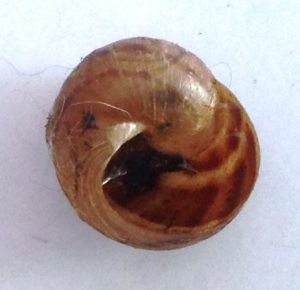
Among the nettles was a small (~1 cm) snail – one of the Amber snails – whose aperture is longer than the spire. Although there are two very similar species, I think this one was Succinea putris, which frequents wet places.

Spider of the month has to be the garden spider, Araneus diadematus Although most are not yet fully grown, they are actively renewing their webs every morning.

Olwen Williams

June sightings

High summer!! A alternating mixture of rain and heat has provided an excellent growing season and some spectacular flowers. In my garden, bumble bees are investigating the honeysuckle and foxglove flowers. In particular, the Common Carder (Bombus pascuorum) and the Garden Bumblebee (B. hortorum) have long tongues and are able to reach into the deeper flowers. I have also seen the Early Bumblebee (B. pratorum) here.

In Paradise, there is a nest of Tree Bumblebees (B. hypnorum), recognised by its combination of ginger thorax, black abdomen and white tail. The nest is in a willow tree about 8 ft off the ground and is patrolled by ardent males, waiting for the virgin queens to emerge. These bumblebees are relative newcomers to UK, having arrived only in 2001 from Continental Europe, but are spreading widely and have reached both Ireland and Scotland.

Tree Bumblebee Bombus hypnorum

In the heat, the river is a popular place to swim. However, there is a warning of the “river itch”, especially on hot days. This is caused by the larvae of a flatworm, whose primary host is a snail. The free-swimming larvae seek their secondary host, a duck, but may mistakenly attack a swimming human. Apart from an irritating rash, the larvae are harmless to us.

There seem to be exceptional numbers of singing Blackcaps and I am also hearing Chiffchaff locally. The Song Thrushes are still vocal and a little pile of broken snail shells indicates where they are feeding.  Skylarks sing over the Grantchester fields, but I have not heard a Yellow Hammer there this year. The local Herons are noisier than ever, now that the young are hatched and courting is overtaken by childcare duties.

In the house, I disturbed a very large House Spider (Tegenaria domestica). I left him there, hoping his diet includes my current plague of Clothes Moths. There seem to be very few flies for him this year. A recent publication* states that there has been a

decline of about 80% in the biomass of insects over the last few decades (since 1989). I wonder why?

Olwen Williams

*http://www.sciencemag.org/news/2017/05/where-have-all-insects-gone?ad_id=2336&utm_source=NHBS+News+%26+Updates&utm_campaign=f239c7a10b-ento_where_have_all_the_inse_06_02_2017&utm_medium=email&utm_term=0_9dd4930fe0-f239c7a10b-58705889&mc_cid=f239c7a10b&mc_eid=5a75c2dd6c

May sightings

The early UK spring foliage and flowers cannot be beaten – returning from a trip to the tropics, I found Cambridge spring in full flood. Elderflower is now adding to the heady scent of the May blossom and cow parsley. Lots of migrant warblers are here now, but it was a great delight to hear a Cuckoo from my back doorstep on May 2nd.

“The cuckoo comes in April,                                                                                           He sings his song in May.                                                                                               In June, he changes his tune                                                                                      And in July he flies away.”

Then on May 10th, the first screams of airborne Swifts, returning for their summer holidays. The UK must be the only place they ever touch down, as they nest and rear young here, but otherwise live their lives on the wing. I expect Bob will tell us where in Cambridge they are nesting.

Mayflies have hatched in Paradise, Newnham’s local nature reserve. The new pond there provides quiet water and lots of emergent vegetation, while excluding large predatory fish. For a few days each spring, evening swarms can be seen as the males search for a female before ending their brief adult lives.

Above the gate and near the chapel in Trinity Great Court, House Martins are busy flying in and out from their nests. By the river in Newnham, a Grey Wagtail investigated the waterside vegetation.

A massive effort was made to clear the invasive Floating Pennywort from the upper river last autumn. At one point, it had spread right across the river. Happily, there is no sign of it at the moment.

My spider of the month is Araneus diadematus.  This well known Garden Spider is generally associated with autumn, but at breakfast on May 18th, I found a newly hatched mass of spiderlings in a communal web.  Yellow and black, there must have been about one hundred of them, clustered together. When disturbed, they fell away on individual threads like golden raindrops and then gradually reassembled. Within a few hours, they had climbed up into the tree and disappeared.

On 31st May, while swimming in the river, I saw a barn owl crossing the river to the Skaters Field nature reserve in Newnham. It was early evening and the owl was moth-like and white in the sunshine. I had been told that they were about, but this was the first time I had seen one.

Olwen Williams

April sightings

April sightings

Spring seems to be advancing in fits and starts. We have had a series of night frosts and cold winds, with one magnificent hail storm. However, at the same time, sunny days mean that the spring is well advanced and most of the May blossom is out before May has even arrived. Cow parsley blooms at the same time, the two together providing a double layer of white and a sensational scent.

Cow parsley

My local Song Thrush is putting in overtime!  I hear him throughout the day – maybe a minute’s pause as he moves from one tree to another, to establish territory – but a continuous flow of small repeated phrases in a fluty whistle. He is still going at dusk! Last year was very good for slugs and snails, so hopefully he will be mopping up a few of these.

A family of Hedgehogs has been spotted in Arbury Rd and in Chesterton, there are reports of Toads in the garden.  All good news.

Olwen Williams


March Sightings

March Sightings

Working on the allotment, I became aware of the clacking noise of Fieldfares, which I thought had gone for the year. Shortly afterwards, a flock of 25-30 flew in ragged formation towards their summer home in Northern Europe.  A Little Egret flew lazily over – a smaller white version of the herons who continue their noisy nest-building. Then a pair of Sparrow Hawks wheeled overhead, temporarily silencing the songbirds. Song thrush, blackbird, robin, wren, great and blue tits were all competing for airspace, while rooks, jackdaws and great spotted woodpecker drumming provided the accompaniment. Then, a week after the fieldfare departed, I heard my first spring migrant, a Chiffchaff calling on March 13th.

Suddenly the slugs and snails are active.  My Iris unguicularis (the lovely purple spring ones) were savagely mauled overnight and a replete Brown-lipped Banded Snail (Cepaea nemoralis) could be seen retreating for the day after a busy night!

A bumblebee queen appeared at breakfast in the back garden – still too dark to see which species and she did not stop.  Also found this week was an Ichneumon Wasp, Amblyteles armatorius, in shiny black and yellow livery.  These are fairly common, especially on flower heads in summer.  Spring is upon us!

Spider of the month is Salticus scenicus, which have just emerged from winter hibernation. Otherwise known as Zebra or Jumping Spiders, these tiny spiders love to hunt on the sun-warmed brick wall in my back garden.  They can be very tame, jumping onto clothing or hand to investigate, but are impossible to catch. They have superb vision with four enormous eyes in a front row, two small ones a little further back and another two large ones behind these.  All round vision enables them to stalk and hunt prey without becoming the prey of something larger.

Frogs are active too, though sadly none in my pond for the last couple of years.  Have they deserted West Cambridge?  I have common newts and occasional toads in the garden.   Do you have anything to report?  Let us know!

Olwen Williams

February sightings

Valentine’s Day (Feb 14th) is traditionally when birds start their courtship. Bang on cue, I was greeted at breakfast by the local Herons, wheeling in pairs over their nesting site in Newnham and   vocalising. Let us not call it song! Squeals, yelps, grunts, squawks, honks, barks, growls, clucks, squeaks and hisses are interspersed with vigorous bill clattering – quite the noisiest courtship ever. The heronry appeared in Newnham a few years ago and seems to be doing fairly well. In the summer of 2015, I counted a crèche of 14 juveniles standing around in the field waiting for the adults to reappear with food.

A few years ago, the churchyard of Little St Mary’s Church was rescued from a totally over-grown state and is now a shaded and secluded garden. I found Winter Heliotrope (Petasites fragrans), in bloom and fragrant. This has been the site of a place of worship since around the twelfth century and it is tempting to wonder if some of its plants may have existed on this spot for many generations. Its cousin, butterbur, is not yet in flower, but there is a large patch in the Paradise Nature Reserve, known to exist there since the 1600s. Meanwhile, on a Sarcococcus bush in the churchyard, early Honeybees were enjoying the fragrant flowers.

Winter heliotrope

As winter progresses, my log pile gets ever smaller and I am careful to brush off any animals which live there. This month’s spider is the Lace-weaver Spider, Amaurobius similis. They are about 10mm long, mainly brown with a patterned abdomen and very common in houses and gardens. They lurk between the logs, weaving a wispy, blueish web, extending from a hole between the logs. In this retreat, eggs are laid in a silken sac and on hatching, their first meal might well be the mother who has not survived them!


Amaurobius similis and web

Olwen Williams

January sightings

This month’s highlight has been the flock of 24 Waxwings which have been devouring the berries in the front gardens of Cherry Hinton. These beautiful birds are winter visitors from Scandinavia, coming to find a new source of winter food when weather conditions are bad there. They are generally in small flocks, moving from one tree to another. This one was enjoying the rowan berries, in the company of the occasional mistle thrush.

I am always intrigued by Rooks and Jackdaws. The tall trees near the river in Newnham may contain as many as 300-400, in a mixed flock. I know that there is a very large roost at Madingley, described in detail in 1931 and probably there for very much longer. Outside the breeding season, several thousand birds (of both species) congregate there each night from far and wide – even as far as Manea in Fenland. In the mornings, they disperse and sometimes only a few come my way. Other mornings, between dawn and sunrise, there is a massive noisy flock, wheeling and turning in the sky. They settle briefly and then go about the day’s business. Later, at tea time, they reassemble before returning to Madingley – a trip of about 4 miles and taking just a few minutes. (I imagine they are much quicker than the car-bound commuters on the same journey!)

However, Newnham does not appear to be a rookery – there are no nests there – simply a stop-off place. So where do they spend the day and where are all the rookeries? If you know of any rooks’ nests within the city, please get in touch with us. Also, if you also see large flocks, that would be good to know too.

My spider of the month is the Daddy-Long-Legs Spider, Pholcus phalangioides. This is not to be confused with the other “Daddy-Long-Legs”: the Harvestmen (also arachnids but not spiders) and Crane Flies (long-legged insects with wings). Pholcus is a widespread species, but intolerant of cold. It survives as an indoor inhabitant of houses throughout Europe. You may find them in cupboards and cellars, high up and upside down, in a wispy web. When disturbed, they vibrate rapidly on their very long legs – probably a defence mechanism. Like most spiders, they have eight eyes, but in a very unusual distribution. There are two groups of three and then two tiny ones in the centre. They catch and eat other spiders, small flies such as mosquitoes and even woodlice – so entirely harmless and welcome house guests. Any in your cupboards?

Olwen Williams

December records

snailshellDid you know that spiders sometimes eat snails? Hanging from spider silk attached to the eaves above the back door, I found this empty shell of an immature garden snail. Wondering how on earth it could have got there, I consulted the
Oracle and found several records of spiders attacking and eating snails, including a video clip.

It was at the site of a garden spider web (Araneus diadematus).

The garden is generally quiet at this time of year, but after some unseasonably warm days, I have heard wood pigeon, green woodpecker, song thrush and wren all calling as if it were spring. A great spotted woodpecker sat at the top of a large tree, calling persistently, but I have not yet heard him drumming. By the river, siskins are investigating the alder trees – they love the seeds. My front garden has been adopted by a robin, keeping guard over the feeding station from a perch in the quince tree.

Cambridge is generally surrounded by green belt – fields and agricultural land. Some of their hedge boundaries are ancient. Oliver Rackham, an eminent Cambridge woodland ecologist, described the application of Hooper’s Rule here. Hooper maintained that the average number of woody species in a 30 yard stretch of hedge was roughly equivalent to the number of centuries the hedge had been there. By this rule, there are many hedges between Cambridge and Grantchester which must be 500-600 years old! I wonder how many there are which are threatened by the proposed development of West Fields for a busway? If you know of hedges in Cambridge which may be interesting and ancient, we would be very happy to come and survey them – please get in touch.

Olwen Williams

November records

At this time of year, autumn colours are always a race between frosty nights and high wind.  Well, the frosty nights have come and the colours deepened, but now many leaves have blown off in the wind, so walking has become a childhood pleasure, through drifted piles of green, yellow, pink, red, plum and brown, to match the November fireworks.

OLYMPUS DIGITAL CAMERA

OLYMPUS DIGITAL CAMERA

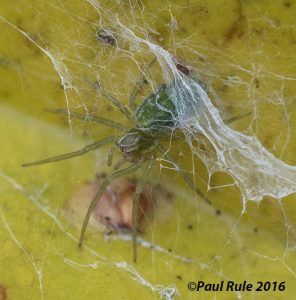
Some insects are still active.  Ivy flowers provide a valuable food source in November and a late wasp was seen on these (above). A common darter was spotted on a stone wall (right).  Under a rough web, on a fallen leaf, a 3mm bright green spider lurked – Nigma walckenaeri (below).OLYMPUS DIGITAL CAMERA

It is always a surprise to visitors that cattle graze the meadows along the Cam, even in the middle of the city.  Over the last few weeks, they have mostly been housed for the winter, no longer depositing their dung pats across the water meadows.  However, under the pats it is far from dead!  The larvae of dung beetles and dung flies survive over-winter as chrysalises, to emerge as adults in the spring.  Fungi break down the dung, worms and plants invade it, rain and frost contribute to decay and soon the nutrients are returned to the soil.

There are still lots of other fungi around.  In Paradise Local Nature Reserve, a huge willow tree was felled about three years ago, after it became dangerously decayed in the middle.  The logs were piled beside the path and now host various bracket and other fungi.  Altogether, I found 15-20 different species in the wood, including oyster mushrooms.

Olwen Williams, 11 November 2016