
All posts by Bob Jarman

A snout at the Snout and LBJs (Little Brown Jobs)

Snout Corner is in the most north-easterly 1×1 km square of our project area. This monad and the the 1×1 km square just below, adjacent to the A14, are mostly winter wheat and sugar beet farm land and quite barren for birds. But …the adjacent fields just outside our project area are weedy cereal stubbles full of Yellowhammers, finches and wintering thrushes – a good example of the value and diversity that over-winter stubbles offer as bird habitat in intensive farmland. I have seen Roe Deer at Snouts Corner in the past but have records of up 16 Roe Deer seen there recently. There is a public footpath and it is worth a visit!

I received an interesting record of a male Stonechat from the Histon Road allotments from Ben Greig, which he saw in February 2017. This is a good record – stonechats are rare birds in our study area and within the county are uncommon winter visitors and passage migrants and only occasional breeders, mostly to open weedy marginal land in the fens. I have seen only two before in our study area on farmland just south of the A14. The margins around the ponds at Eddington look like potential stonechat sites.

Female Stonechat

Little Brown Jobs (LBJs) are birds that can be very difficult to identify. Immatures, females of some species and moulting adults cause problems. A classic LBJ is the Dunnock (Hedge Sparrow). Tweet of the Day recently featured the Dunnock with a commentary by Dermot O’Leary (X-Factor compère). He has big respect for this bird because it always seems busy – a grafter! But this bird has its secrets. A classic study by Nick Davies many years ago in the Cambridge Botanic Gardens showed that female dunnocks select an alpha male but also sneak off to mate with a beta male: she is polyandrous. The young are the offspring of both males and all three adults feed the young. It’s a brilliant strategy: if the Alpha male is taken by a predator it still leaves two adults to raise the chicks.
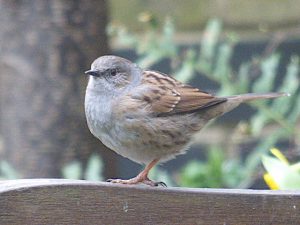
DunnockDunnock

A note in the September/October Bulletin of the Cambridgeshire Bird Club says: Studies of the Cambridge Peregrines have shown that as well as feral pigeons, prey items include Teal, Shoveler, Grey Partridge, Golden Plover, Bar-tailed Godwits, Black-tailed Godwits, Woodcock, Common Tern, Blackbird, Redwing and Starling. These birds may not have been caught over the City. I suspect the City birds travel out to the Ouse Washes (Earith to Sutton Gault). I have seen birds travelling out of Cambridge on several occasions and this seems a regular direction.

Also mentioned in the CBC Bulletin is a fascinating study of night time calls of flyover birds including a record of Ortolan Bunting over our study area. Ortolan Bunting has never been seen in Cambridgeshire and is a rare east coast passage migrant from central Europe. In autumn plumages it is a classic LBJ!.

Bright days in winter often encourage Mistle Thrushes to sing. Their mournful song from the top of a tall tree gives hope of warmer and longer days ahead, I have heard two birds singing recently in Fen Ditton and Midsummer Common. I have seen them feeding on the grassy roundabout and singing from the tree tops at the junction of Chesterton Road and Elizabeth Way.

Duncan’s blog with photographs of Buzzards over the City is spectacular. Buzzards breed just outside our study area.

We now have Buzzards, Peregrines and occasionally Red Kites over the City. Red Kites have bred in our study area. In October 2016 at the junction of Gilbert Road with Histon Road, a Peregrine made a pigeon kill. It was being closely tailed by a Red Kite; the kite was probably hoping the falcon would drop the pigeon which it could then steal. All this happened at roof top height!

An unexpected LBJ in my bird feeder – a Wood Mouse?

1st December

bobjarman99@btinternet.com

Buzzards over Cambridge

I was walking along Parkers Terrace this morning and the house sparrows which are always in a very chirpy mood, seemed to be quite agitated. Then right above us 3 buzzards circled slowly going round and round surveying the ground below. I immediately rushed up to my office and grabbed my camera and climbed onto the roof of the shop.  Just in time to get a series of images before they moved away altogether.

The little images show how variable  these same birds of prey can look when flying.  All were taken within a few seconds of each other. It takes a practiced eye to identify them correctly all the time.

Buzzards are showing a big increase in numbers from the low point in the 1960s. But they started to increase in numbers from about 1990 and the present population is 6 times that of 1967. This is probably due to more rabbits being resistant to Myxomatosis, fewer organochlorine pesticides, and less persecution.  They are breeding in lots of the woodland in the countryside around Cambridge, but its not often you see them right over the city.

27 October 2017

Duncan Mackay

November – a season of ……… Hawfinches!

The Hawfinch is one of our most secretive and elusive woodland birds. In the 1950s they bred in the Botanic Gardens and along “the Backs”; in the 1970s and 1980s they retreated to the parklands near Newmarket. Now our nearest breeding birds are in the Brecks. In winter, they are tree seed eaters and, its claimed, can crack a cherry stone in their huge bill. This winter there has been an exceptional influx that has filtered inland from the east coast often accompanying Starling flocks. The reason must be a winter food shortage in northern Europe. Flyover birds were recorded over Lovell Road by John Heath on 16th, 31st October and 3rd November (about a dozen have been seen in Wimpole Park); doubtless more will turn up. They have a distinctive flight call – an explosive “tak” given on the up-beat of their strong undulating flight. Keep an eye open for them around Beech, Sycamore, Yew and Hornbeam trees in our study area.

A Chiffchaff in Logan’s Meadow on 1st November is probably an over-wintering bird. A Blackcap in Benson Street, feeding on Mahonia nectaries, is likely to be the first of our visiting wintering birds rather than the last of our summering birds; it was singing a very quiet and subdued sub-song. A Woodcock, disturbed in the evening of 1st November in Petworth Street, Petersfield, was an unusual record (Salim Algailani). Woodcocks venture into urban areas when temperatures freeze in the wider countryside and soils in gardens are still soft enough to probe for worms and grubs. I suspect this bird was an overflying night migrant that may have been hunted by our City Peregrines and fled to a nearest land fall refuge. Peregrine pellets found in Nottingham city centre from local nesting Peregrines have been found to contain bones of night flying migrants including Water Rails and Woodcocks.

The young Peregrine found wounded with .22 pellets just outside our project area, probably a bird from one of the City nest sites, is still recovering at the Raptor Foundation (See Olwen’s October blog). It might recover but may never be fit enough to hunt so, sadly, will be destined for a life in captivity.

Redwings have arrived in numbers (good places to see them: the winter lawns of Cherry Hinton Park and the Botanic Gardens); the first big flock of Fieldfares passed over Chesterton on November 1st.

Black-headed Gulls have arrived to over-winter along the river from Riverside to Jesus Lock. There are few 1st year birds amongst the large majority of winter-plumage adults which suggests a poor breeding season.

Adult winter plumage Black-headed Gull – Riverside (above)

The winter Cormorant roost in the willows opposite the Riverside chimney is beginning to assemble.

The land set aside for building development between Huntingdon Road and Histon Road, that has been fallow for about eight years, is now being landscaped and having access roads laid; sad but inevitable as the countryside is pushed further and further out.

Barn Owl (Neil Sprowell) (above)

This year five Kestrels (two adults and three juveniles) regularly hunted over this site; over winter 15/16 four Short-eared Owls roosted there and over winter 16/17 a female Hen Harrier was present. In earlier years, Merlin hunted for Skylarks.
Kestrel – Huntingdon Road (above)

Barn Owls (see Neil Sprowell’s photo above – Cambs Bird Club Gallery) are seen there regularly and have been present on this northern edge of our study area for the last 60 years at least! The Barn Owls and Kestrels will probably remain but will be forced further out.

7th November 2017
bobjarman99@btinternet.com

Autumn thugs and the gentle passage to Winter

Skuas (Jaegers in the USA) are the dark mean-looking gull-like thugs of the seas that terrorise  gull and terns into regurgitating food for their own consumption. From 1990 to 1995 local birdwatchers staked out the rivers Ouse and the Nene mouths at the south of the Wash to observe Skua passage. Hundreds were seen passing south down the rivers.

The theory is that they migrate overland at a great height following the north-east/ south-west trajectories of the Ouse/Cam and the Nene river valleys to the Severn estuary – a migration short cut. The theory suggests they pass over our project area but too high to be visible.

Arctic Skua (courtesy Bill Schmoker) (above)

Great Skua (right)

Illustration by Graham Easy of Skua migration over Cambridgeshire (1990 Annual Report of the Cambridgeshire Bird Club No 64)

Graeme Easy produced a very evocative drawing of Skuas over Milton (left)

Recently birds have been seen passing overland through the Great Glen in Scotland on a path from the Irish Sea to the North Sea on their way to their breeding grounds in our northern Isles and Scandinavia. Look up on a stormy day with strong NE winds! On 14th September this  year (2017) Jonathan Taylor saw 62 Great Skuas heading south into Cambridgeshire at Foul Anchor, north of Wisbech. There is at least one record of a Skua in our project area: a juvenile Arctic Skua at a local farm reservoir in January!

Ten Common Buzzards high over Huntingdon Road on 6 October were probably passage birds; a Chiffchaff singing in Logan’s Way had probably lost its way! Redwings heard over Cambridge on 1st Oct and a Brambling over Cambridge on 8th October (reported by Jon Heath) are early winter visitors; a Common Redstart was seen at Eddington.

(Grey) Herons are tough cookies! There is one heronry in our project area in Newnham. Little Egrets often breed in heronries but where our local Little Egrets breed is an enigma. Garden ponds stocked with ornamental fish are regular targets for herons, especially young birds.

Grey Heron (left)  watchful, waiting, for the chance and poised to fly down to a garden pond in Chesterton (below)

The Tawny Owl survey in our project area has found 5 nest sites, 4 in west Cambridge in the Newnham/Grange Road area. Please send me any records of breeding or single birds. Sparrowhawks (see September blog) are now probably commoner in urban areas than the wider countryside where farmland birds have declined.

October 2017 bobjarman99@btinternet.com

Autumn Watch and Eddington

A few late Swifts were recorded, probably passage birds: 1 over Huntingdon Road on 3rd September, 5 over Addenbrooke’s, the next day, September 4th, and 6 over Chesterton on 15th; September Swifts are unusual. A Chiffchaff was singing in the rain in Fulbrooke Road on the 15th September and a Hobby over Huntingdon Road on the same day.

Keep an eye open for unusual migrant birds that find safety in numbers amongst flocks of tits coming to garden feeders. A very small garden can attract passage Whitethroat, Lesser Whitethroat, Willow Warbler, Reed Warbler even a Yellow-browed Warbler. In a week to ten days, over-wintering Redwings will be heard flying over at night with their high pitched “sseep, sseep” contact call.

Cambridge has a new suburb (or is it a new village?) on the north- west of the city – Eddington; named after the astronomer and mathematician Arthur Stanley Eddington (1882-1944). Between the buildings and the M11 are a group of balancing ponds to mitigate flooding. They already have breeding Little Grebes; Kingfishers have been seen and in the early stages of the project the bare soils and gravels attracted breeding Lapwings and Little Ringed Plovers. In 2015 only 8 breeding pairs of Little Ringed Plovers were found in Cambridgeshire. Kestrels bred on one of the housing blocks under construction, which stopped work until the chicks fledged. Some Swift and House Sparrow nest boxes have been integrated into the build. It an impressive sustainable development and well worth visiting and is part of our project area.

Just a mile away to the east on farmland in our project area, five pairs of Lapwings nested on a field of short barley stubble in spring 2015 – the first time on this site for at least 50 years! Sadly, all nests failed probably due to predation by corvids and despite careful farm operations that marked each nest.

I try hard to like Crows – it’s respect more than like. A paper in the recent British Wildlife (Stoate, 2017) says that controlling nest predators such as Carrion Crows and Magpies increases nest survival rates for vulnerable species such as Song Thrushes, Blackbirds and Spotted Flycatchers. It makes uncomfortable reading!


Little Egret (left); Cattle Egret (right) – Chesterton Fen April 2016

Until 1988 sightings of Little Egrets were so rare that records required a written description to be accepted. (“Medium sized pure white heron with a black bill and legs and bright yellow feet. Period!”) In 1989, 40 turned up along the south coast of England and the remarkable colonisation of the UK began.; they first bred in Dorset in 1996; in 2016, 82 were counted at Burwell Fen near Wicken. Last year I saw two fly over Arbury where I lived as a boy; such an occurrence would have been unthinkable then. Where they breed is enigmatic! They can be seen regularly in Coe Fen and Newnham and along Snakey Path between Romsey Town and Cherry Hinton – almost any shallow water area, ditch or dyke. But beware, amongst farm stock it could be a Cattle Egret! In April 2016 Jon Heath found a Cattle Egret in our project area on Chesterton Fen. It is slightly smaller with a yellow bill and yellowish/green legs and feet.

Three Tawny Owl records so far: two in the Newnham/Coe Fen area and one in Sidgwick Avenue. Please send Tawny Owl records to nathistcam@gmail.com  or to me at the email the address below giving date, location – street name. All records will be confidential and also forwarded to the County Bird Recorder.

Stoate, C. 2017. The Allerton Project’s first 25 years. British Wildlife 28:392-397.

September 2017  bobjarman99@btinternet.com

The Swifts have gone – 2017

Swifts breeding in our study area have mostly gone – there seemed to be major overnight departures on Tuesday 1st and Saturday 5th August but a few remained over Chesterton until 12th August. Since then occasional birds are probably over-flying migrants moving south but about 10 were feeding with swallows over Midsummer Common on 20th August. Two pairs used the Swift Tower on Logan’s Meadow and at least 10 nest boxes on Edgecombe Flats, near Campkin Road, were occupied. A Chiffchaff, singing in Huntingdon Road on 12th August, was probably a passage bird confused by a spring-like sunny day.

August is wader passage time. Overflying night migrants that often call include Whimbrels, Godwits and Green Sandpipers. On a clear night listen for their contact calls especially if the prevailing winds are from the north or east. An examination of prey from Peregrine Falcons nesting in Nottingham found the remains of night migrants such as Water Rails, Nightjars and waders.

The two pairs of nesting Peregrines in our project area both reared two young. One of the young from the City centre crash landed in Caius College and spent five days R&R at the Raptor Foundation near St Ives. It was then successfully reunited with its parents in the City.

Our project has four new surveys and we are asking for records. One of these surveys is for Tawny Owl records. From August young Tawnies are ejected from parental territories and attempt to set up their own home patch. They can fetch up in any wooded area, including our gardens, especially if near open ground where they can hunt small mammals and earthworms – Tawny Owls are great worm eaters! The “tuwit too- wooo” is an amalgam of the female call – “tuwit” or better a sharp “kerwick” and the male call – “ too-whoo”. There is a breeding pair with well fledged young in Sidgewick Avenue.

Please send Tawny Owl records to nathistcam@gmail.com or to me at the email the address below giving date, location – street name. All records will be confidential and also forwarded to the County Bird Recorder.

Sparrowhawk (left)
© Frank Bell 

Another raptor common in the City is the Sparrow hawk. A male was displaying over Logan’s Meadow Chesterton at the beginning of August – why? Probably, like the Chiffchaff, inspired by a warm day rather than a late nesting attempt. Sparrowhawks were our commonest raptor until 1960 but agricultural pesticide poisoning caused them to become extinct in Cambridgeshire for 25 years until a nesting pair was discovered in a wood in the west of the County in 1985. Since then numbers have recovered and now they are probably as common as they ever were. It is difficult to estimate their current population in our project area but it is possibly 10-15 breeding pairs.

Little Egret on the Snakey Path (left)  © Bob Jarman

Future bird projects in our study area will include, (Grey) Herons, Little Egrets and wintering thrushes: Redwings and Fieldfares. Redwings will be with us very soon – early birds arrive on the coast at the beginning of September. Redwings are frequent night migrants and can be heard passing overhead with a high, drawn out, “seep” contact call.

August 2017

bobjarman99@btinternet.com

It’s been a good year for – Warblers

Blackcaps are still singing in Logan’s Meadow which suggests a second or even a third breeding attempt this year. In Rustat Road, in an unkempt patch about 3m x 3m at the end of a well-cared for garden, Chiffchaffs were feeding young in mid-July and others still singing in Huntingdon Road gardens. The Willow Warbler on Coldham’s Common with the “chiff chaff” notes at the end of its song was also still singing in mid-July.

Chiffchaffs have out-numbered Willow Warbler by about 10:1 in our project area this year. Apart from the Coldham’s Common bird, the only Willow Warblers I have heard have been along the river opposite Fen Ditton and three singing in the birch thicket near the new Cambridge North Station.

The July issue of British Birds has a paper which suggests Willow Warblers have declined in southern England while populations in the north have remained stable or have increased.


Willow Warbler – above

Blackcap (female) – below

The average shift north of 122 species of British birds is about 20.4 km or 1-km per year or almost 3m per day! (Pearce-Higgins 2017). A good example is the Spotted Flycatcher which used to be regular in our NatHistCam project area but is now a rarity. In Scotland, especially around sheep pastures, it is still common.

The Cambridgeshire Bird Club has a current project on the present distribution of the Spotted Flycatcher – if you have any recent records (from anywhere in Cambs) please let Michael Holdsworth know: spofl@cambridgebirdclub.org.uk.

The reasons for this move north are probably related to climate change and a decline in insects. The BBC’s Farming Today reported that the banned neonicotinamide insecticides, that some believe are responsible for the decline in bee species, are still widely used on non-flowering agricultural crops such as sugar beet, turnips and kale to reduce aphids and the transmission of virus yellows.

Common Tern on Riverside (below)

A pair of Common Terns can still be seen regularly feeding along Riverside often heading down river with food; if you know where they are breeding please let the Cambridgeshire Bird Club know: recorder@cambridgebirdclub.org.uk

Marbled White on Coldham’s Common (left)

Has it been a good year for butterflies? The Marbled White is a species that has increased in recent years and has expanded its range from chalk grassland to grassy corners. This year I have seen them on a farm site in the north of our project area and on Coldham’s Common. There is an excellent book: The Butterflies of Cambridgeshire published by the Cambridgeshire and Essex Butterfly Conservation Branch that is well worth buying!

Field, R. Perrin, V. Bacon, L. Greatorex-Davies, N. (2006) The Butterflies of Cambridgeshire. Butterfly Conservation Cambridgeshire and Essex Branch – ISBN 0-9554347-0-X; 978-0-9554347-0-9
Pierce-Higgins, J.W. 2017. Birds and Climate Change.
British Birds 110:388-404.

Bob Jarman 24th July 2017

Wintering Blackcap Survey – update July 2017

In the last 30 years a sub-population of Blackcaps from central Europe have developed a new migration route. Ringing recoveries show that our wintering Blackcaps come from Germany and Austria and have travelled in a WNW direction. The typical migratory route is SW to over-winter in the Iberian Peninsula and Morocco. The belief is that our warming winters and especially garden feeders are the reasons Blackcaps are over-wintering. From January to March 2017 we received Blackcap records from 28 locations in our project area in the City. Twenty-eight locations seemed good and so the records were consolidated into our project.


Male blackcap (right)

Female Blackcap “Browncap” (below)


That changed when I received a letter from Margaret Risbeth on 21st a long-time member of the Cambridgeshire Bird Club. She sent me a detailed log of records of Blackcaps seen in her garden in Hinton Avenue, Cambridge. At the end of her records of Blackcaps in her garden she concluded that:

  • The wintering birds left by March 18th – how did she know? Because the winter birds never sang to establish a breeding territory.
  • The summer migrants arrived on March 23rd – how did she know? Because the summer arrivals sang to establish territory.
  • The summer Blackcaps never use the garden feeders – the wintering birds do.

Bill measurements from captured over-wintering birds show that winter birds have thicker bills than summering birds which may be a micro-adaptation to feeding on seeds and fat balls in garden feeders.

To extend Margaret’s observations further it maybe that Blackcaps are showing evolutionary behaviour with changes in morphology (bill thickening), physiology (ability to digest seeds and fat balls) and behaviour (new migration route). A reasonable comparison would be the evolution of Darwin’s Finches on the Galapagos Islands (incidentally, not discovered by Darwin!).

To extend the analysis even further what we might be seeing is the “micro-evolution”, in the last 30 years, of a new clone or even sub-species. What happens in central Europe, when our wintering population returns and meet Blackcaps that have arrived from their SW migration, could tell us whether a new population is evolving. Wait long enough and birders may get another species tick!

4th July 2017

bobjarman99@btinternet.com

Peregrines – update June 2017

The City centre Peregrines have reared two chicks. One fell onto the pavement below and was rescued. The second chick is fully feathered and now glowers down onto the street below waiting for the parent birds to return with prey.

Below: Juvenile Peregrine photographed on 17th June 2017

The second city pair has two healthy chicks. At the beginning of June a dead Buzzard was found close to their nest site. At some nest sites Peregrines have been seen to kill Common Buzzards – presumably they see them as a predatory threat. This dead Buzzard appeared uninjured and on close examination turned out to be a Honey Buzzard!

Honey Buzzards are rare breeding birds with about 50 breeding pairs in the UK and very occasional annual passage migrants over the City in the first weeks of May. A June record is exceptional. Could this be one of a pair that is breeding locally?

The Peregrines at this second city site often nest with a pair of Kestrels and Stock Doves nesting closely nearby without any apparent antagonism!

A female Black Redstart has been seen at a central City location – no male has been seen or heard so it’s likely this lone individual is an unpaired female on an early return migration. But its show they maybe about in the City; central Cambridge, around the colleges and churches, is a likely location.

Bob Jarman 19th June 2017

Winter in Mozambique or catching pigeons in the Market Square?

One of our most exciting spring migrants is the Hobby, a swift-shaped falcon. Satellite tagging has shown they spend their winters catching termites in Mozambique. One or two pairs probably breed on the edges of our project area; hunting birds are often over the City and were recently seen over Huntingdon Road and Chesterton. In the early 1960’s this species was confined to the New Forest and Dorset heaths. Slowly, it expanded its range and by 1964 there may have been 1-2 pairs nesting in Cambridgeshire. Until the 1960’s this species was a target for bird nesters. It uses disused crows nests and is faithful to suitable breeding sites; a breeding site in the north of our project area has probably been used for the last 25 years. It nests late and entire clutches were stolen to order. Once taken the birds did not usually lay again and if they did the eggs were often stolen for a second time.

The ban on egg collecting and more importantly enforcing the ban enabled the Hobby to expand from its New Forest strong-hold. Crows were less persecuted so the number of potential nest sites increased. The extraction of gravel in the Home Counties and into Cambridgeshire created open water gravel pits for it to feed on one of its favourite prey items – dragonflies.

While Hobbys are away in winter chasing termites in southern Africa, the City’s Peregrines are catching feral pigeons in the Market Square or wildfowl on the Ouse Washes.

The male Peregrine of our city centre nesting pair on watch some distance from the nest on 15th May – it’s a good sign! The heavy rain the next day on the 16th is a worry as the nest was partially water-logged last year and one chick was lost.

Common Terns have returned and are regularly fishing from Jesus Green to Riverside to Horningsea and Bait’s Bite. Where they breed is a mystery but in August young birds can be seen harassing the adults for food.

The Common Terns below Elizabeth Way Bridge; one of them swallowing a fish about half the size of the bird itself!

There are at least two singing Whitethroats in bushes along the river on Logan’s Meadow. It’s probably our commonest “scrub” warbler; its pleasant short scratchy song is often the prelude to a towering song flight, a rather clumsy hover and then parachute descent into a bush. Nearby are Treecreepers nesting in one of the nest boxes put up by the Council.

 Male Yellow Wagtail                                Whitethroat

Yellow Wagtails are much less common than they used to be. They are birds of meadows and damp pasture. This bird was photographed in a wet puddle near the Histon Rd/Huntingdon Road footpath on the 11th May. They have adapted to agricultural arable crops and occasionally nest in oilseed rape in the north of our project area. A study by Bill Jordan for the Cambridgeshire Bird Club found fenland birds often nested in potato and pea crops.

Male Yellow Wagtails have (probably) the dullest song of all our passerines: “slurp, slurp, slurp” or if you are lucky: “slurp, slurp, slurp, slurp”, but their striking yellow plumage says it all!

So far no definite sight or sound of Black Redstarts in the City.

Couldn’t resist a couple of butterfly pics; a Brimstone, left, on a Primrose and a rather battered Speckled Wood that had probably emerged from hibernation; both taken near Histon Road.

Bob Jarman

17th May 2017